Estes Park, Colorado
High in the Rocky Mountains, overlooking Lake Estes, is the popular resort town of Estes Park, Colorado. This scenic area was once a refuge to those inflicted with tuberculosis, due to its cool, dry atmosphere. This is the very reason F.O. Stanley, who was afflicted with pulmonary tuberculosis, and his wife Flora would choose to move here in June of 1903.
The inventor of the Stanley Steamer, Freelan Oscar Stanley first arrived in Denver in March of 1903. On a recommendation from his physician, Dr. Charles Bonney, he would then relocate 70 miles North to Estes Park. After seeing a great improvement in his condition, as well as falling for the beauty of the land, Stanley soon began construction of his home “Rockside”.
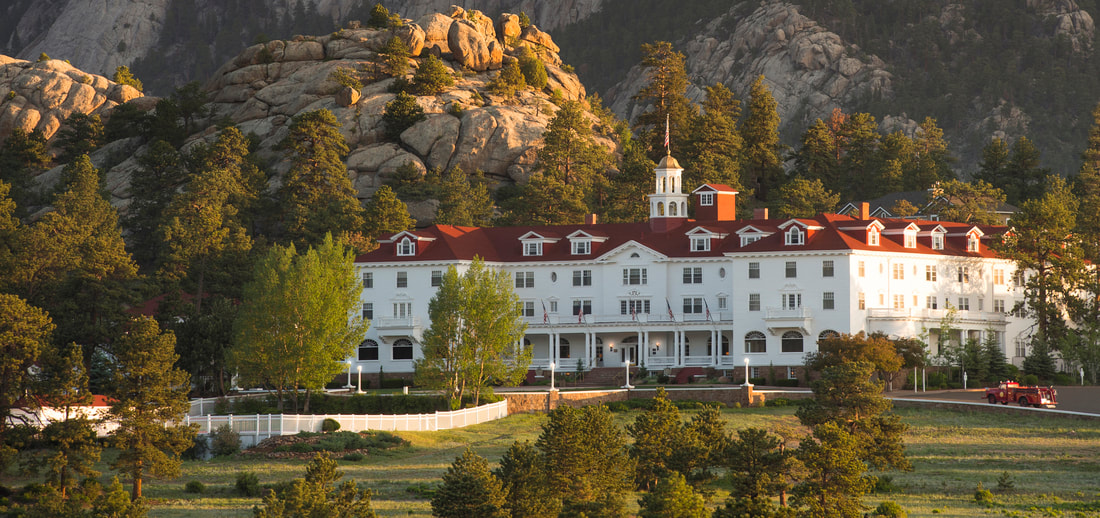
In 1907, having fully recovered, F.O. Stanley began the construction of his grand hotel, The Stanley. The Colonial Revival style hotel consisting of 48 rooms and a concert hall, would be completed in 1909. Stanley Manor – now referred to as The Lodge – was completed soon after in 1910. Upon its completion, The Stanley was one of the first hotels in the world to be powered entirely by electricity.
Over the years, The Stanley would see construction several times to improve and expand on its accommodations and amenities. The East Wing was expanded to add more guest rooms, the hydraulic elevators were replaced with cable-operated lifts, and a veranda was enclosed to create the room now used as a gift shop, just to name a few of the upgrades.
The Stanley Through the Years
Since its inception, The Stanley has hosted numerous guests of prestige, including President Theodore Roosevelt, the “Unsinkable” Molly Brown, and Emperor Akihito (and family) of Japan, to name a few. It would also play host to numerous filming crews who would use the establishment for motion pictures, documentaries, and television specials. It is most famously recognized as the “Overlook Hotel”, from Stanley Kubrick’s 1980 adaptation of the Stephen King novel The Shining, which it helped to inspire. In addition to the film, it would reprise its role as the “Overlook Hotel” in The Shining miniseries (1997).
In 1926, F.O. Stanley sold the hotel to the Stanley Corporation. After only three years of operation, the Stanley Corporation filed for bankruptcy. Freelan purchased the hotel back from the Stanley Corporation in 1929, only to sell it to Roe Emery, a man known as “the father of Colorado tourism”. Actually, the hotel would continue to change hands many times over the decades. Currently, the hotel is being operated by the Grand Heritage Hotel Group, who has owned the property since 1995. At present, the hotel boasts 420 guest rooms, as well as multiple ballrooms, dining halls, a separate concert hall, a private bed & breakfast, and residential condos.
Despite no longer being the hotel’s proprietor, Freelan and Flora continued to spend time at the hotel. Flora, an accomplished pianist, spent countless hours on the piano in the front lobby, while Freelan lounged in the smoking and billiard rooms. In 1939, Flora suffered a stroke in the lobby of the hotel. She died later in her home, Rockside, on July 25. Shortly after Flora’s death, Freelan returned to his home in Newton where he passed of a heart attack on October 2, 1940.
Paranormal Activity
As far as paranormal activity goes, The Stanley has it all. The hotel even offers “Spirited” rooms on their website that can be booked by paranormal enthusiasts. Night Tours are also available for those looking to explore the hotel’s darker side. The entire hotel is plagued by phantom sounds and voices, apparitions, and light anomalies. Employees and guests both report being tugged, poked, and even shoved by invisible hands.
Stanley and his wife Flora are seen on the ground floor. Flora has been seen and heard playing the piano; a frequent experience that began shortly after her death in 1939. Stanley, too, is often seen pacing the lobby and keeping an eye on staff. A woman, whose identity is unknown, has been seen, and photographed, as she descends the main staircase. One unfortunate manager had books fly off of the shelf at him as he worked behind the front desk.
Beneath the hotel, you’ll find a 100-yard corridor carved right through the limestone foundation. Having been used by staff for many decades, it’s no surprise to hear frequent reports of cold winds, shadow figures, and disembodied voices echoing throughout the space. Employees have also reported having their clothing tugged on, as if by children. Many believe the sounds and sensations felt throughout the employee passageways are residual, but some have been known to interact intelligently with the living.
Explosion in Room 217
In 1911, disaster struck the grand hotel. Despite being designed to run on electricity, The Stanley would suffer from a lack of available power sources. It was forced to install an auxiliary gas lighting system in June, 1911. Immediately after installation, on June 25, a chambermaid entered Room 217. A flame from the light she carried sparked an explosion that rocked the hotel. It destroyed the entire west wing of the hotel, nearly 10% of the establishment. Reports differ on whether the maid was killed or merely injured during the event; with most reporting that she broke her ankles after falling through the floor to the dining room below.
In fact, there are so many conflicting reports, no one knows for sure what truly transpired that day. The name of the woman, her fate, and the number of victims altogether differs. For instance, some claim she was Elizabeth Wilson or Lambert of Lancaster, Pennsylvania. Another post called her “Lizzie” Leitenbergher. Some reporters claim that other maids were present during the explosion (possibly Eva Colburn and Mary Donaldson), but were not seriously injured and helped to put out the ensuing blaze.
Today, Room 217 is one of the more active rooms. Despite varying reports on the maid’s name and survival of the incident, staff and guests both attribute the activity in the room to “Mrs. Wilson”. She is said to turn down beds, unpack luggage, and tidy up after visitors. However, Mrs. Wilson is a very traditional woman. If an unmarried couple comes to Room 217, the activity becomes less welcoming. Lights flicker, luggage is packed and placed near the door, and a cold presence is said to materialize right in the middle of the bed!
The Fourth Floor
Up on the fourth floor – which was once the attic and living quarters for staff – the activity is at its strongest. Children’s voices are heard playing in hallways, usually very late at night. Some guests have witnessed a red ball bouncing up and down the hallway, as if being thrown between two children. A phantom dog is said to paw at the doors of guest rooms.
Room 401 is said to be the most active. Personal objects move and sometimes disappear entirely. Closet doors open and close on their own. One unfortunate guest was awakened in the middle of the night by the dark figure of a man standing at the foot of his bed. The figure walked over to the bedside table, picked up the guest’s wedding ring, and then retreated into the closet, shutting the door behind him. The startled guest rushed to the closet, opened the door and found nothing! The ring was never recovered.
Guests looking for a good night’s rest should avoid Room 428. Those who have braved a night in this room report the sounds of heavy footsteps and the sound of furniture being dragged across the floor above them. The only problem is that there is no floor above Room 428! Since the Fourth floor was once the attic of the old hotel, there is no longer space between the rooms and the roof. Perhaps the sounds they hear are related to the spectral cowboy seen standing at the end of the bed.
Other Active Areas
The MacGregor Room, a dining venue with a stage, is often the scene of spectral parties. Kitchen staff have often heard the sounds of music, laughing, and glasses clinking. Upon investigating, they’ll find the room empty. They also report phantom footsteps following them across the hardwood floors. This room was used to film The Shining miniseries, with Stephen King, the author himself, making a cameo appearance.
The Manor, being a completely separate building, is not immune to the disturbances that haunt the main hotel. Housekeepers have reported cleaning and locking Room 1302, only to find it completely disheveled moments later. Windows open and close on their own. Lamps will turn on and off, and sometimes even leap from the bedside tables.
The Concert Hall, located next to the main hotel, is one of the original structures completed in 1909. The ghost of ‘Paul’, who was once a handyman for the hotel, is said to hang out here. He nudges people when he’s not getting enough attention, and issues a firm “Get out!” to anyone hanging around after 11pm (the hotel’s original curfew). Paul’s not alone, though. He’s accompanied by the friendly spirit of “Lucy” who is often eager to communicate. Lucy is believed to have been a homeless woman who broke into the Concert Hall for shelter. One harsh winter she was found frozen to death in the venue’s basement. Screams often heard throughout the hall have been attributed to Lucy.
A Lasting Legacy
The legendary Stanley Hotel is among the most luxurious and beautiful hotels in the world; as well as the most haunted. Located in the Rocky Mountain National Park, it attracts visitors from around the globe. The property provides a variety of accommodations, dining venues, entertainment, and paranormal activity. The Stanley is a must-have on every ghost hunter’s bucket list.
Contact
333 E Wonderview Ave
Estes Park, Colorado 80517
Phone: (970) 577-4000
Affiliations
Book a Tour
Stanley Hotel Tours
Accommodations
The Stanley Hotel
Dining & Entertainment
Claim This Space!
Suggested reading