Auburn, Alabama
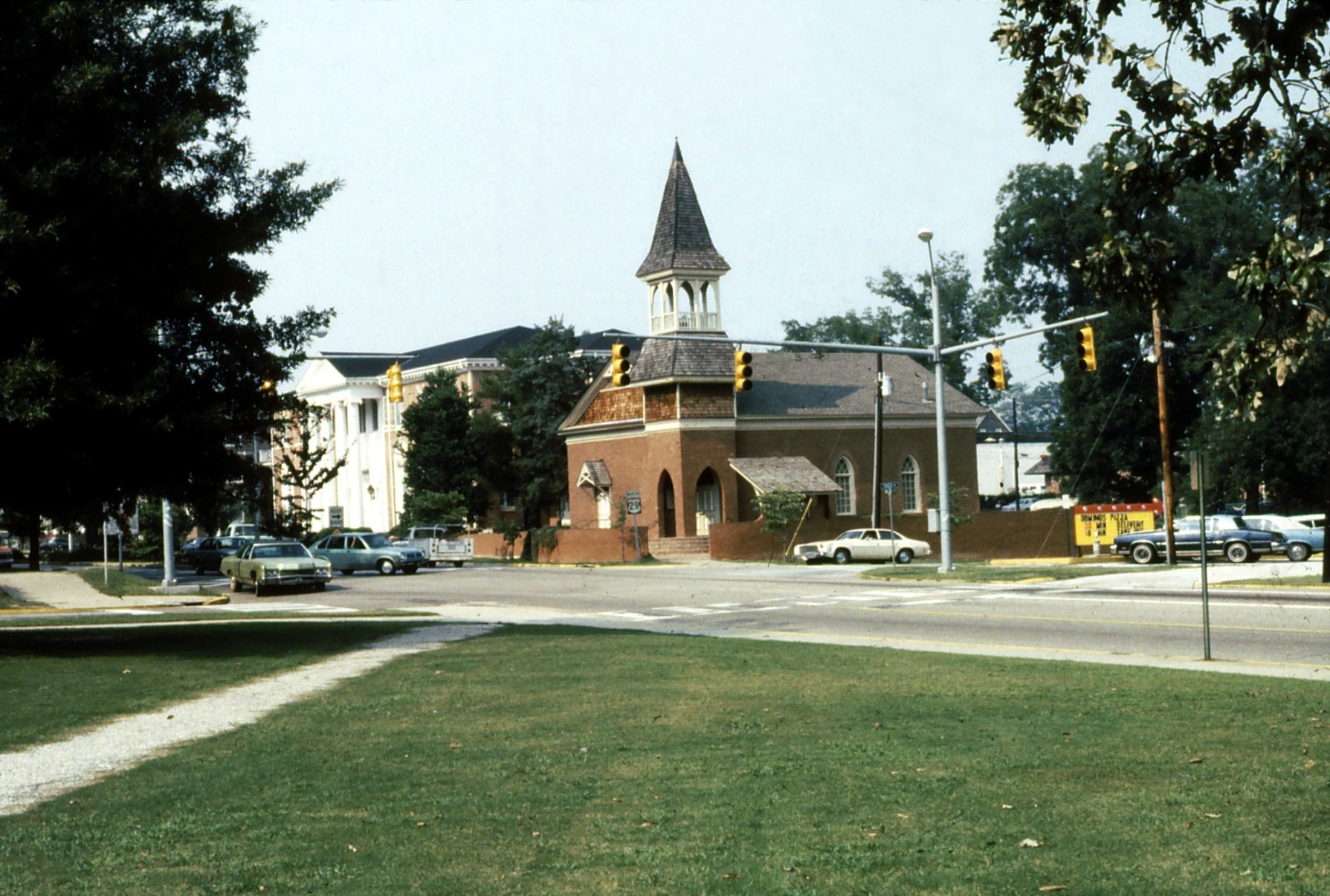
Standing as the second-oldest building in Auburn, and the oldest still on its original site, the Auburn University Chapel carries a long and layered past. Built in 1851 as a Presbyterian church, the structure quickly became a cornerstone of the community. Its original Greek Revival design reflected the architectural taste of the era, but the building’s function soon shifted with the tides of history.
During the Civil War, the chapel was transformed into a Confederate hospital. Here, soldiers wounded in battle were treated within its walls, tying the chapel forever to Auburn’s wartime legacy. After the war, the building adapted once again to serve the community’s needs.
When the Alabama Agricultural and Mechanical College (later Auburn University) lost its main building to a fire in 1887, the chapel provided temporary classrooms while the college rebuilt. In 1900, the structure underwent a renovation that dramatically altered its appearance: the original Greek Revival style gave way to a Gothic architectural design that endures today.
Ownership shifted in 1921, when the chapel was sold to Auburn University. It was first used as a YMCA and YWCA center before being handed over in 1927 to the Auburn Players Theatre, the university’s acting troupe. For nearly fifty years, the chapel was filled with rehearsals, performances, and audiences until the troupe moved to the Telfair Peet Theatre in 1973.
Following another major renovation from 1973 to 1976, the building was converted into the interdenominational chapel it remains today—a quiet sanctuary rooted in both religious and university life.
Paranormal Claims
The chapel’s reputation for ghostly activity emerged during its decades as the home of the Auburn Players. Students and actors reported unexplained whistling echoing from the attic, accompanied by phantom footsteps. Props were said to move on their own, and floating lights were witnessed drifting through the space.
Perhaps most intriguingly, reports of strange phenomena—whistling, moving props, and unexplained lights—did not remain behind when the Auburn Players relocated in 1973. The activity was said to have followed the troupe to the Telfair Peet Theatre, fueling the belief that the haunting was more attached to the performers than to the building itself.
The Legend of Sydney Grimlett
Curiosity about the haunting led several students to experiment with a Ouija board. According to their accounts, the entity they contacted identified himself as Sydney Grimlett, a British-born volunteer in the Confederate army. Sydney allegedly suffered a grievous injury in 1864 when cannon shrapnel struck his leg. By the time he received treatment, the wound had become gangrenous. He supposedly died during an operation to amputate the leg and was said to have been buried in Pine Hill Cemetery.
However, historical research tells a different story. No ancestral or military records have ever been found for a man named Sydney Grimlett. Likewise, there is no record of anyone by that name interred in Pine Hill Cemetery. In fact, no documentation exists to confirm that such a person ever lived, let alone died in the chapel. The absence of evidence strongly suggests that the legend of Sydney Grimlett was a fabrication, likely born out of the Ouija board session itself and passed down as folklore among Auburn students.
Legacy
Today, the Auburn University Chapel stands as both a living place of worship and a monument to the city’s evolving history. From a Presbyterian church to a Civil War hospital, from a stage for the performing arts to a spiritual refuge, the building has worn many faces.
The legend of Sydney Grimlett continues to be retold as part of the chapel’s ghostly lore, but with no historical evidence to support it, it serves as a reminder of how myths can grow around places with a long past. Whether one views it as a true haunting or a tale born of imagination, the Auburn University Chapel remains one of Auburn’s most storied sites—where history, memory, and folklore intertwine.
Contact
139 South College Street
Auburn, Alabama 36830
Phone: (334) 844-1320
Affiliations
Book a Tour
Claim This Space!
Accommodations
Claim This Space!
Dining & Entertainment
Claim This Space!
Suggested Reading